Soft, cozy, and wonderfully giftable, a baby boy crochet blanket is one of those handmade projects that never goes out of style. The inspiration here combines the calm blue, aqua, cream, and white tones often used in baby blankets with simple textured rows that create a neat, gently ridged fabric. The result is a classic blanket that feels special without requiring complicated colorwork or advanced crochet techniques.
This original interpretation uses a two-color lemon peel stitch design worked back and forth in rows. Narrow horizontal color bands give the blanket a look similar to the striped baby blankets shown, while the simple stitch pattern adds subtle texture and keeps the fabric flexible and warm. It is a practical free crochet pattern for a baby shower gift, nursery blanket, stroller blanket, or everyday snuggle blanket.
Key Takeaways
- A classic rectangular baby boy crochet blanket with soft horizontal stripes.
- Uses the easy lemon peel stitch, making it approachable for confident beginners.
- Suggested worsted-weight washable yarn creates a practical, cozy fabric.
- The base pattern finishes at approximately 30 x 36 inches, or 76 x 91 cm.
- The width and length can be adjusted using the simple stitch and stripe multiples.
- Blue and cream are suggested, but the pattern works beautifully with many nursery color combinations.
The Baby Boy Crochet Blanket Design
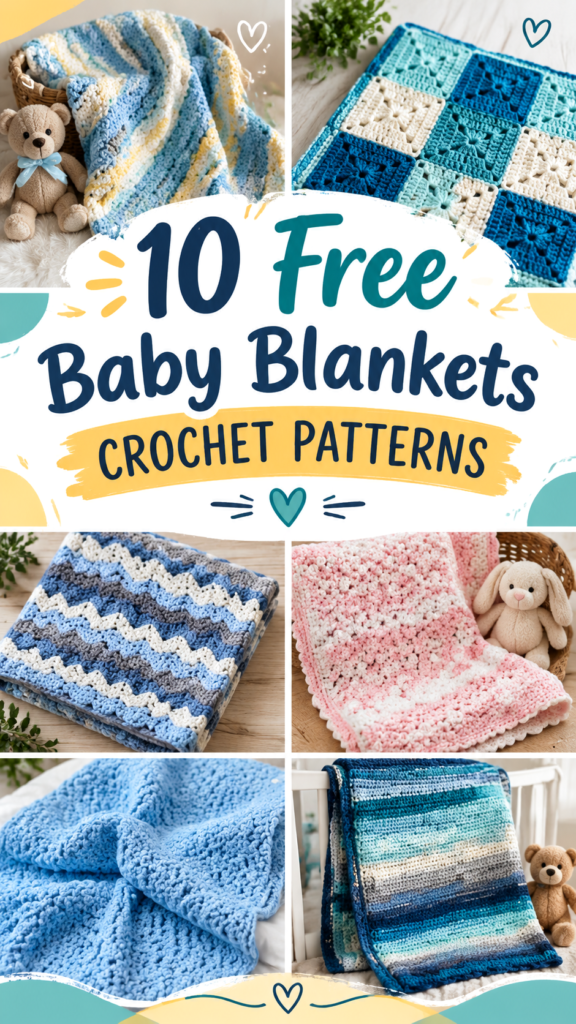
The blankets pictured feature several different crochet approaches, including stripes, textured fabrics, geometric motifs, and granny-style squares. The most useful common theme is the soft nursery palette. Blues ranging from pale aqua to deeper denim pair naturally with cream, ivory, gray, and white, creating a timeless look that suits both traditional and modern nurseries.
For this original pattern, the design is simplified into a rectangular striped blanket. Rather than attempting to reproduce any unseen original pattern, this version uses a practical construction that captures the visual feeling of the inspiration while giving crocheters a complete set of instructions.
What Makes This Blanket Beginner Friendly?
The blanket is worked entirely in rows. There are no individual motifs to sew together, no complicated shaping, and no difficult lace techniques. The main stitch alternates single crochet and double crochet, creating the familiar lemon peel texture. Because the stitch count remains the same throughout the body, you can concentrate on maintaining even tension and changing colors neatly.
The stripe sequence also makes the project easy to follow. Each color section is six rows tall, producing balanced bands that are noticeable without overwhelming the soft texture. The final border is worked around all four sides to give the blanket a clean, finished edge.
Best Uses for the Finished Blanket
- Baby shower or new baby gift
- Nursery accent blanket
- Stroller or car-seat cover while supervised
- Tummy-time or play blanket
- Cozy lap blanket for a growing child
- Handmade keepsake for a baby’s first year
Safety Tip: For babies and young children, choose securely constructed, washable materials and avoid loose buttons, beads, long ties, or detachable decorations. A handmade blanket should not be treated as medically tested or sleep-safe bedding. Follow current safe-sleep guidance for infants and use blankets appropriately under supervision.
Crochet Construction and Stitch Texture
The original pattern is designed as a simple striped rectangle worked from the bottom edge upward. Each row contains exactly 120 stitches. The lemon peel stitch alternates single crochet and double crochet across the row, then reverses the stitch type over the next row. This creates a small pebbled texture rather than a completely flat fabric.
For the suggested gauge, 16 stitches and 14 rows measure approximately 4 inches by 4 inches in the main stitch. With 120 stitches across, the blanket measures approximately 30 inches wide. The 126-row body measures approximately 36 inches long before the border is added. Your finished measurements can vary slightly depending on yarn, hook, and personal tension.
Crochet Insight
Lemon peel stitch is especially useful for baby blankets because it produces texture without creating large open spaces. Keep your single crochet and double crochet tension consistent. If your double crochets become noticeably taller or looser than your single crochets, the fabric can develop an uneven surface.
The suggested colors are a soft medium blue and a warm cream. For a cooler nursery palette, substitute pale aqua for the blue. For a more traditional appearance, use navy, powder blue, and ivory. A neutral gray, sage green, or dusty blue can also be substituted without changing the stitch instructions.
Free Crochet Pattern: Coastal Blue Baby Boy Crochet Blanket
Project description: This original striped baby blanket combines alternating blue and cream bands with a softly textured lemon peel stitch. The construction is intentionally straightforward, making it a relaxing project for confident beginners who want a polished handmade baby gift.
Pattern Overview
| Skill Level | Confident beginner |
| Finished Size | Approx. 30 x 36 in, or 76 x 91 cm, before minor variation from edging |
| Main Stitch | Lemon peel stitch |
| Construction | One rectangular body worked in rows, followed by a simple border |
| Yarn | Suggested worsted-weight, category 4, washable acrylic or acrylic/cotton blend |
| Yarn Quantity | Approx. 1,500 yd, or 1,372 m, total |
| Color A | Approx. 800 yd, or 732 m, soft blue |
| Color B | Approx. 650 yd, or 594 m, cream or ivory |
| Hook | 5.0 mm, US H-8 |
| Gauge | 16 stitches x 14 rows = approx. 4 x 4 in, or 10 x 10 cm |
| Terminology | US crochet terminology |
Pattern note: Exact yarn usage, gauge, and finished size cannot be determined from a finished photograph alone. This original interpretation uses the measurements, yarn category, and hook size above as practical starting recommendations. Make a gauge swatch if you want the finished blanket to closely match the stated dimensions.
Materials and Notions
- Category 4 worsted-weight washable yarn in soft blue, Color A
- Category 4 worsted-weight washable yarn in cream or ivory, Color B
- 5.0 mm US H-8 crochet hook
- Yarn needle for weaving in ends
- Scissors
- Measuring tape
- Optional locking stitch marker for keeping track of rows or color blocks
Terminology and Abbreviations
- ch: chain
- sc: single crochet
- dc: double crochet
- sl st: slip stitch
- st: stitch
- sts: stitches
- RS: right side
- WS: wrong side
- rep: repeat
UK terminology note: US single crochet is UK double crochet, and US double crochet is UK treble crochet. The instructions below use US terminology exclusively.
Special Stitch: Lemon Peel
The lemon peel stitch alternates single crochet and double crochet across a row. On the following row, work a single crochet into each double crochet from the previous row and a double crochet into each single crochet. This reversal keeps the alternating texture consistent from row to row.
Important: The turning chain does not count as a stitch throughout this pattern. Always work the first stitch into the first stitch of the previous row, directly at the base of the turning chain.
Gauge Swatch
Using Color A and the 5.0 mm US H-8 hook, chain 25 and work several rows in lemon peel stitch. After lightly flattening the swatch without stretching it, aim for approximately 16 stitches and 14 rows over a 4 x 4 inch, or 10 x 10 cm, area.
If you have more than 16 stitches in 4 inches, your tension is tighter than the recommendation. Try a larger hook. If you have fewer than 16 stitches, try a smaller hook. The most important measurement for this blanket is the width, so prioritize stitch gauge when adjusting your hook.
Construction Notes
The blanket body contains 120 stitches in every row and 126 rows total. The 126 rows are divided into 21 color blocks. Each color block contains exactly six rows. Color A is used for blocks 1, 3, 5, and so on through block 21. Color B is used for blocks 2, 4, 6, and so on through block 20.
There are 11 six-row blocks of Color A and 10 six-row blocks of Color B. This gives a blue starting section and a blue ending section, with cream sections evenly distributed between them.
Blanket Body: Starting Chain
- With Color A, make ch 121.
- Do not count the starting chain as a stitch.
- The first row will contain exactly 120 worked stitches.
Rows 1 to 6: Color A
- Row 1, RS: Sc in 2nd ch from hook, dc in next ch; repeat [sc in next ch, dc in next ch] across. Turn. 120 sts.
- Row 2, WS: Ch 1, sc in first dc, dc in next sc; repeat [sc in next dc, dc in next sc] across. Turn. 120 sts.
- Rows 3 to 6: Repeat Row 2 four times. Turn after each row. 120 sts after each row.
At the end of Row 6, change to Color B in the final step of the last double crochet. To make the transition neat, work the double crochet until two loops remain on the hook, place Color B over the hook, and draw it through the final two loops. Turn and begin the next row with Color B.
Rows 7 to 12: Color B
- Row 7, RS: Ch 1, sc in first dc, dc in next sc; repeat [sc in next dc, dc in next sc] across. Turn. 120 sts.
- Rows 8 to 12: Repeat Row 7 five times. Turn after each row. 120 sts after each row.
At the end of Row 12, change back to Color A using the same final-stitch color-change method.
Rows 13 to 126: Remaining Stripe Sequence
Continue the same six-row stripe rhythm without changing the stitch count. For clarity, use the following exact color-block sequence:
- Rows 13 to 18: Color A. Repeat the Row 2 lemon peel sequence for all six rows. 120 sts each row.
- Rows 19 to 24: Color B. Repeat the Row 2 lemon peel sequence for all six rows. 120 sts each row.
- Rows 25 to 30: Color A. 120 sts each row.
- Rows 31 to 36: Color B. 120 sts each row.
- Rows 37 to 42: Color A. 120 sts each row.
- Rows 43 to 48: Color B. 120 sts each row.
- Rows 49 to 54: Color A. 120 sts each row.
- Rows 55 to 60: Color B. 120 sts each row.
- Rows 61 to 66: Color A. 120 sts each row.
- Rows 67 to 72: Color B. 120 sts each row.
- Rows 73 to 78: Color A. 120 sts each row.
- Rows 79 to 84: Color B. 120 sts each row.
- Rows 85 to 90: Color A. 120 sts each row.
- Rows 91 to 96: Color B. 120 sts each row.
- Rows 97 to 102: Color A. 120 sts each row.
- Rows 103 to 108: Color B. 120 sts each row.
- Rows 109 to 114: Color A. 120 sts each row.
- Rows 115 to 120: Color B. 120 sts each row.
- Rows 121 to 126: Color A. 120 sts each row.
For every six-row block after Row 12, use the same lemon peel sequence established in Row 2. Change colors at the end of each six-row block. Always turn after completing the row. When Row 126 is finished, do not add another turning chain.
Fasten off Color A after Row 126, leaving a yarn tail of approximately 6 inches, or 15 cm. Secure the loop and weave the tail into the wrong side of the blanket with a yarn needle.
Joining New Colors Neatly
For crisp horizontal stripes, avoid cutting the yarn at every color change if you are comfortable carrying yarn along the edge. However, because this blanket uses only two colors and the border will cover the side edges, cutting and restarting each six-row section creates a very clean result.
When changing colors, make the final color change during the last yarn-over of the final stitch. This prevents a visible loop of the old color from appearing at the stripe boundary.
Border Round 1
Use Color A for the border. Join the yarn with a slip stitch at the upper-right corner of the blanket, preferably in a corner stitch. The exact starting point is flexible, but keep the border consistent once you begin.
- Ch 1. This chain does not count as a stitch.
- Work 120 sc evenly across the top edge.
- Work 3 sc in the top-left corner.
- Work 126 sc evenly down the left side, placing approximately one single crochet at each row end.
- Work 3 sc in the bottom-left corner.
- Work 120 sc evenly across the bottom edge.
- Work 3 sc in the bottom-right corner.
- Work 126 sc evenly up the right side, placing approximately one single crochet at each row end.
- Work 3 sc in the top-right corner.
- Join with a slip stitch to the first sc.
Border Round 1 stitch count: 500 sc. The four groups of three corner stitches are included in this total.
Border Round 2
- Ch 1. This chain does not count as a stitch.
- Sc in the first stitch and in each stitch around the blanket.
- Work 3 sc in the center stitch of each three-sc corner group from Round 1.
- Continue around all four sides using one sc in each regular stitch.
- Join with a slip stitch to the first sc.
Border Round 2 stitch count: 500 sc. Fasten off, leaving a 6-inch, or 15 cm, tail. Pull the final loop through and weave in the end securely on the wrong side.
Finishing the Blanket
- Inspect both sides and locate every loose yarn tail.
- Thread each tail onto a yarn needle.
- Weave each end back and forth through several stitches on the wrong side.
- Change direction once or twice before trimming the excess yarn close to the fabric.
- Check all four corners to make sure they lie flat.
- Measure the finished blanket before blocking.
Pro Tip: When working single crochet evenly along the side of a striped blanket, avoid placing a stitch into every visible loop unless your row height specifically supports that ratio. The goal is a flat edge. If the side begins to ripple, use slightly fewer stitches. If it pulls inward, add a few stitches evenly along the edge.
Blocking and Shaping
Blocking is optional, but it can improve the final shape and make the stripes look more even. For washable acrylic yarn, gentle steam blocking can be used carefully, but avoid pressing a hot iron directly against the fibers. Another option is to lightly dampen the blanket, arrange it flat on a clean surface, smooth the corners and edges, and allow it to dry completely.
Do not stretch the blanket aggressively. The goal is simply to encourage the rectangle to lie flat. Pay special attention to the four corners and the outer border.
How to Customize the Baby Boy Crochet Blanket
Adjusting the Width
The blanket begins with 121 chains to produce 120 stitches. Because the lemon peel pattern alternates two stitch types, use an even number of worked stitches for the easiest adjustment.
To make the blanket wider, add an even number of chains to the starting chain. For example, a starting chain of 141 produces 140 worked stitches. A starting chain of 161 produces 160 worked stitches. Keep the same stitch sequence across the row.
Always make a small gauge swatch before committing to a large blanket. Your personal tension can change the finished width considerably, especially when using a different yarn fiber or hook size.
Adjusting the Length
The base design uses 126 rows. To make it shorter, remove complete six-row color blocks. To make it longer, add complete six-row color blocks. Keeping the stripe sections at six rows each preserves the balanced horizontal design.
For example, 120 rows creates 20 six-row color blocks, while 132 rows creates 22 blocks. If you want the blanket to begin and end in the same color, use an odd number of six-row blocks so the first and final color are both Color A.
Color Customization Ideas
- Classic baby boy: soft blue and ivory
- Modern coastal: aqua and warm white
- Denim-inspired: medium blue and light gray
- Soft neutral: sage green and cream
- Winter nursery: navy and pale gray
- Minimalist: two shades of the same blue
You can also make every stripe a different shade for a gentle rainbow effect. Keep the yarn weight and fiber type consistent so the rows remain similar in height and texture.
Common Mistakes and Troubleshooting
The Stitch Count Keeps Changing
The most common problem with lemon peel stitch is accidentally skipping the final stitch or placing two stitches into the same stitch. Count your stitches at the end of the first few rows. Every body row should contain exactly 120 stitches in the base pattern.
Remember that the turning chain does not count as a stitch. The first stitch is worked into the first stitch of the previous row.
The Edges Are Uneven
Uneven edges usually come from inconsistent turning-chain placement or accidentally working into the turning chain. Since the turning chain is not a stitch in this pattern, ignore it when counting your 120 stitches.
A stitch marker can help identify the first and last worked stitches, especially during the first several rows.
The Blanket Is Too Wide or Too Narrow
Check your stitch gauge before changing the pattern. If your stitches are larger than the recommended gauge, the blanket will become wider and may use more yarn. If your stitches are smaller, the finished blanket will be narrower and denser.
Important: Do not change hook size halfway through the blanket simply to correct a measurement unless you understand how it will affect fabric density. If your gauge is significantly different, unraveling and restarting with a better hook size usually gives a more consistent finished fabric.
The Stripe Transition Looks Uneven
Make the color change during the final yarn-over of the final stitch in the old color. Avoid cutting the yarn immediately after completing the final stitch and then attaching the new color separately, because that can create a small bump at the transition.
Finishing, Care, and Baby-Friendly Considerations
For a frequently washed baby blanket, washable acrylic or an acrylic/cotton blend is a practical choice. Softness varies between yarns, so feel the yarn before beginning a large project. Avoid rough or scratchy fibers when the blanket will be used directly against delicate skin.
Follow the washing instructions for the yarn you select. In general, a washable baby blanket benefits from gentle laundering and thorough drying according to the fiber manufacturer’s care guidance. Store the finished blanket completely dry.
Because this project is intended for babies, keep the design simple. The stripes and textured stitches provide visual interest without requiring buttons, beads, appliques, or other loose embellishments. If you personalize the blanket with embroidery, make sure every thread is securely fastened and trimmed.
For gifting, consider adding a small handmade label that identifies the fiber and care instructions rather than attaching loose decorative objects. The blanket can also be folded into a simple nursery basket or wrapped with a wide fabric ribbon for presentation, provided the ribbon is removed before the blanket is given to a baby.
At a Glance
- Best yarn choice: Soft, washable category 4 worsted-weight acrylic or acrylic/cotton blend.
- Skill level: Confident beginner with basic single crochet, double crochet, chains, and color changes.
- Key technique: Lemon peel stitch worked in six-row horizontal color blocks.
- Size adjustment: Add or remove even numbers of starting chains for width and complete six-row blocks for length.
- Finishing: Two rounds of single crochet create a simple, stable border around the blanket.
A Cozy Handmade Crochet Gift
This baby boy crochet blanket brings together everything that works beautifully in a handmade nursery project: soft colors, simple construction, gentle texture, and plenty of room for personalization. The striped lemon peel stitch creates a polished surface without requiring complicated techniques, making it a relaxing choice for an experienced crocheter and a manageable challenge for a confident beginner.
Before starting, choose a soft washable yarn, make a gauge swatch if the finished size matters, and read through the complete pattern so the stripe sequence is familiar. Keep your stitch count consistent and take your time with color changes for the cleanest result.
Most importantly, make the blanket your own. Change the blue to aqua, navy, dusty blue, sage, or another nursery-friendly shade. Add more six-row blocks for a larger blanket or remove blocks for a smaller version. With a few thoughtful changes, this free crochet pattern can become a unique handmade gift that fits the recipient and the room beautifully.
Tags
Baby Boy Crochet Blanket
Free Crochet Pattern
Baby Blanket Crochet
Easy Crochet Blanket
Beginner Crochet Pattern
Crochet Baby Gift
Striped Crochet Blanket
Lemon Peel Crochet Stitch