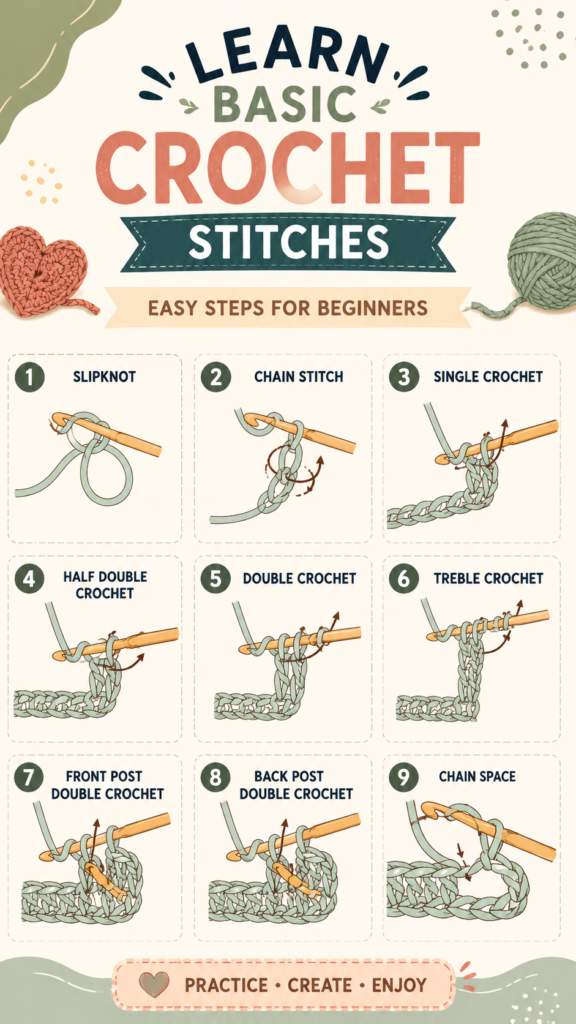
Crochet is one of those creative skills that can begin with a single loop of yarn and grow into an endless world of handmade possibilities. Learning the basic crochet stitches gives beginners the foundation needed to create everything from simple scarves and dishcloths to textured blankets, accessories, garments, and decorative projects. With a crochet hook, yarn, and a little practice, even the most complicated-looking designs become easier to understand.
The key is to focus on the building blocks. Once you understand how to make a slip knot, create a chain, and work through the most common crochet stitches, you can start reading patterns and experimenting with different textures and shapes. This beginner-friendly crochet guide explores the essential stitches, explains how they work together, and shares practical tips to help you gain confidence with every row.
Key Takeaways
- Mastering basic crochet stitches creates a strong foundation for future projects.
- The chain stitch and single crochet are excellent starting points for beginners.
- Double and treble crochet stitches add height and create a more open fabric.
- Post stitches introduce texture and dimension to crochet designs.
- Practicing consistent tension makes stitches neater and easier to identify.
- Learning stitch names and abbreviations helps you follow crochet tutorials and patterns.
Why Learning Basic Crochet Stitches Matters
Every crochet project is built from a combination of simple movements. A finished blanket, cardigan, amigurumi toy, or decorative item may look impressive, but many designs rely on the same basic stitches repeated in different ways. Learning these stitches first helps you understand what your hook is doing and how each new loop contributes to the final fabric.
Basic crochet stitches also teach important skills such as controlling yarn tension, counting stitches, turning rows, recognizing the top of a stitch, and understanding where to insert the hook. These techniques may seem small, but they are essential for creating projects with even edges and consistent sizing.
Important: Crochet becomes much easier when you stop trying to make every stitch perfect immediately. Focus first on understanding the motion of the hook and the order of each step. Consistency usually develops naturally through repetition.
The Essential Crochet Stitches for Beginners
A basic crochet stitch guide often begins with the foundation techniques before moving into taller stitches. Each stitch has a different height and appearance, which means it can change the texture, density, and drape of a project. Learning the following techniques provides a versatile starting point for many beginner crochet ideas and tutorials.
1. The Slip Knot
The slip knot is usually the first step before beginning a crochet project. It creates an adjustable loop that sits on the crochet hook and starts the foundation chain. Although it is technically not a crochet stitch, it is an essential skill for almost every project.
To make a slip knot, create a loop with the yarn, pull a section of yarn through that loop, and tighten it gently around the hook. The loop should move easily along the hook without becoming too loose or too tight.
Beginner Tip
Do not pull the slip knot too tightly. The hook should slide comfortably through the starting loop so you can make the first chain stitch without fighting against the yarn.
2. The Chain Stitch
The chain stitch creates the starting foundation for many flat crochet projects. It is also used throughout patterns to form spaces, turning chains, decorative details, and open sections of fabric. Learning to make an even chain is one of the most important early crochet skills.
After placing the slip knot on the hook, wrap the working yarn over the hook and pull it through the loop already on the hook. Each new loop creates another chain. Continue until you reach the number of chains required for your project.
Beginners often make their first chains too tight. This can make the next row difficult because there is little room to insert the hook. Try to keep your hand relaxed and make each chain similar in size.
3. Single Crochet
Single crochet is one of the most useful basic crochet stitches. It creates a short, compact stitch that works well for projects that need structure and a dense texture. You will find it in beginner projects, toys, bags, borders, washcloths, and countless other designs.
To make a single crochet, insert the hook into the target stitch, yarn over, and pull up a loop. You will have two loops on the hook. Yarn over again and pull through both loops. The result is a neat, short stitch.
Single crochet is ideal for beginners because the sequence is easy to remember and provides plenty of practice with basic hook control. Once you are comfortable with it, you can experiment with working into different loops or changing the placement of the hook to create new textures.
4. Half Double Crochet
Half double crochet sits between single crochet and double crochet in height. It creates a fabric that is slightly taller and often has a softer, more flexible appearance than single crochet.
Begin by yarning over before inserting the hook into the stitch. Yarn over and pull up a loop so that you have three loops on the hook. Yarn over again and pull through all three loops at once.
This stitch is useful when you want a project to grow more quickly than single crochet while still maintaining a fairly solid texture. It works beautifully in scarves, hats, blankets, and many beginner-friendly crochet projects.
5. Double Crochet
Double crochet is one of the classic stitches that every beginner should learn. It is taller than half double crochet and creates a more open, airy fabric. Because it adds height quickly, it is popular for blankets, shawls, sweaters, and other projects where speed and drape are important.
Start with a yarn over, insert the hook into the stitch, yarn over, and pull up a loop. Then yarn over and pull through two loops. Yarn over once more and pull through the remaining two loops.
The repeated pull-through process may feel complicated at first, but it becomes rhythmic with practice. Double crochet is also a useful stitch for understanding how taller crochet stitches are constructed.
6. Treble Crochet
Treble crochet is taller than double crochet and creates a noticeably more open fabric. Before inserting the hook, wrap the yarn around it twice. After pulling up a loop, you will work through the loops in pairs until only one loop remains.
Because of its height, treble crochet can make projects grow quickly. It is often used in lacy designs, openwork patterns, textured stitch combinations, and decorative crochet projects.
When learning treble crochet, concentrate on the sequence rather than trying to move quickly. Count the loops on the hook and complete one pull-through step at a time.
Why This Matters
The difference between crochet stitches is not just appearance. Stitch height affects the size, density, drape, texture, and speed of a project. Learning several basic stitches gives you more control over the finished result and helps you understand why patterns use one stitch instead of another.
How to Add Texture With Post Stitches
Once you feel comfortable with the basic flat stitches, post stitches are an exciting next step. Instead of inserting the hook into the top loops of a stitch, you work around the vertical post of a stitch from a previous row. This changes the surface of the fabric and creates raised or recessed textures.
7. Front Post Double Crochet
A front post double crochet is worked around the front of the vertical post rather than through the top of the stitch. The stitch is pulled forward, creating a raised ridge on the surface of the fabric.
Front post stitches are often used to create strong texture. They can appear in ribbed fabrics, decorative patterns, cables, and detailed crochet designs. The basic movement is similar to double crochet, but the hook placement changes.
8. Back Post Double Crochet
Back post double crochet is worked around the vertical post from the back. This pushes the stitch away from the front surface, creating a recessed effect.
When front post and back post stitches are combined, they can produce a ribbed appearance. This technique is especially useful for cuffs, hat brims, and textured crochet panels.
Practice Idea
Make a small sample swatch and alternate a row of front post stitches with back post stitches. This simple exercise makes it easier to see how hook placement changes the appearance of the finished fabric.
Understanding Chain Spaces in Crochet
A chain space is an intentional open area created by making one or more chains and skipping or spacing stitches according to a pattern. These open sections are useful for decorative designs, lacy projects, and stitch combinations that need room for later rows.
Chain spaces may appear as small gaps between stitches. A pattern can ask you to work into the space itself rather than into the top of a stitch. Learning to identify these openings is an important step toward reading more advanced crochet patterns.
Chain spaces also demonstrate an important principle of crochet: not every part of the fabric has to be filled with a dense stitch. Open spaces can add flexibility, visual interest, and structure to a design.
How to Practice Crochet Stitches Effectively
Practicing each stitch separately is helpful, but combining them in a small sample can improve your understanding even more. You do not need to start with a complicated project. A simple practice swatch gives you space to repeat the motions without worrying about a final result.
- Make a foundation chain that is long enough to hold several stitches.
- Work one row of single crochet.
- Add a row of half double crochet.
- Continue with double crochet and treble crochet.
- Repeat the stitches to compare their height and texture.
- Try front and back post stitches after creating a few stable rows.
This kind of sample becomes a visual reference. You can compare the stitches directly and learn how each one changes the fabric.
Pro Tip: Use a smooth, light-colored yarn when learning basic crochet stitches. It is easier to see individual loops and identify where the hook should go. Highly textured or very dark yarn can make early practice more difficult.
Common Beginner Crochet Mistakes and How to Fix Them
Making Stitches Too Tight
Tight stitches are one of the most common beginner challenges. When the yarn is pulled too firmly, it becomes difficult to insert the hook into the next stitch. Try loosening your grip and allowing the yarn to move smoothly through your fingers.
Losing or Adding Stitches
If the edges of your project become wider or narrower, you may be accidentally adding or skipping stitches. Count your stitches at the end of each row, especially while learning. A stitch marker can also help you identify the first or last stitch.
Confusing the Turning Chain
Different patterns treat turning chains differently. Some count as a stitch, while others do not. Always check the pattern instructions before beginning a new row.
Trying to Crochet Too Fast
Speed comes naturally after the movements become familiar. Slow practice gives you time to see each loop and understand every step. Accuracy and comfort are more valuable than speed in the beginning.
Beginner Crochet Project Ideas to Try Next
After practicing the essential crochet stitches, the next step is to use them in small, enjoyable projects. Simple projects help turn repetitive practice into something useful and motivating.
- Washcloths: Great for practicing rows of single or half double crochet.
- Scarves: Excellent for repeating one stitch and improving consistency.
- Simple coasters: Small projects that let you practice stitch counting and shaping.
- Granny-style motifs: Helpful for learning chains, spaces, and double crochet.
- Textured swatches: Perfect for experimenting with front and back post stitches.
- Small accessories: Fun opportunities to combine several basic crochet techniques.
Choose a project that matches your current skill level. A small finished item can provide more motivation than starting a large project before you feel comfortable with the basic stitches.
At a Glance
- Start with a comfortable slip knot and relaxed chain.
- Use single crochet to build confidence and control.
- Learn taller stitches to create faster-growing, more open fabric.
- Try post stitches when you are ready to explore texture.
- Practice regularly and count your stitches as you learn.
Build Your Crochet Skills One Stitch at a Time
Learning basic crochet stitches is the beginning of a creative journey filled with endless possibilities. From the first slip knot and chain stitch to textured post stitches and open chain spaces, every new technique adds another tool to your crochet skill set.
You do not need to learn everything in one sitting. Practice one stitch, understand how it works, and then move to the next. Over time, the motions become more natural, your tension becomes more consistent, and patterns become easier to follow.
The best way to improve is simple: practice, create, and enjoy the process. A small amount of regular crochet practice can quickly turn basic stitches into the foundation for beautiful handmade projects.
Keep your hook and yarn nearby, revisit the essential stitches whenever you need a refresher, and enjoy watching your skills grow one loop at a time. Whether you are making your first beginner project or building toward more detailed designs, these crochet basics will continue to support your creativity.
Conclusion
Mastering basic crochet stitches opens the door to a wide range of creative projects. The slip knot, chain stitch, single crochet, half double crochet, double crochet, treble crochet, post stitches, and chain spaces each play an important role in building skill and confidence.
Start with the fundamentals, keep your practice relaxed, and allow yourself time to learn. Every stitch you repeat helps develop better control and a deeper understanding of how crochet works. With patience and curiosity, simple beginner techniques can become the starting point for countless handmade creations.
Tags
Crochet Ideas Crochet Tutorials Basic Crochet Stitches Crochet for Beginners Easy Crochet Crochet Techniques Yarn Crafts