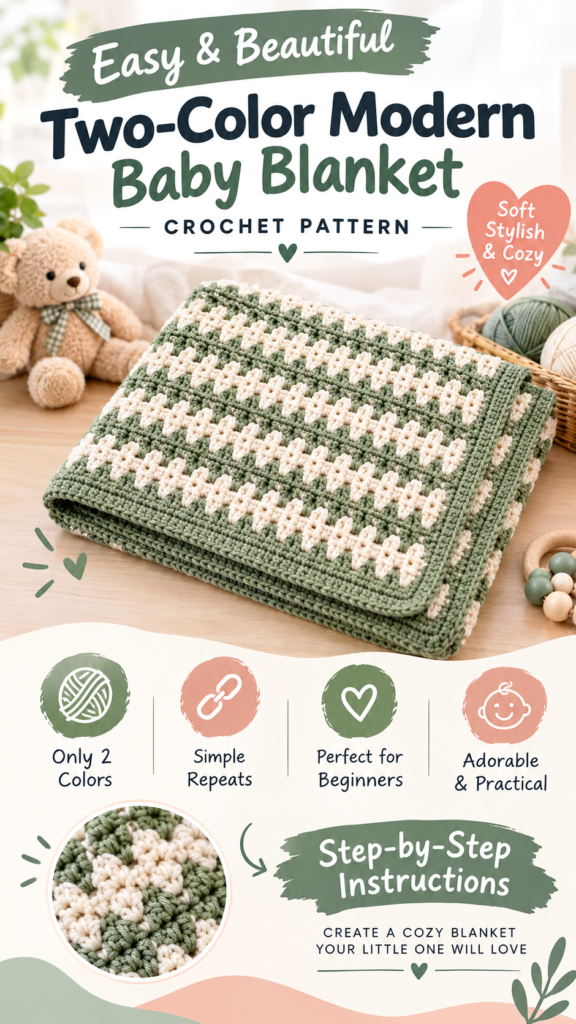
This 2 color baby blanket crochet design combines a soft sage green with warm ivory to create a calm, modern nursery look. The simple two-color arrangement lets the stitch texture do the work, making the blanket feel detailed without becoming overly complicated.
The original interpretation below uses alternating rows of two basic stitches to create a softly raised, woven-looking surface. The blanket is worked flat in rows from one edge to the other, with one color used per row and the yarn changed at the end of each row. A simple single crochet border gives the finished blanket a neat frame and helps the edges stay defined.
This is an approachable project for a confident beginner who is comfortable with single crochet, half double crochet, turning chains, and changing colors. The finished size is suitable for cuddling, stroller use, nursery decoration, or gifting. Because the exact yarn, gauge, and construction of a finished photographed blanket cannot be confirmed from appearance alone, the measurements and materials below are practical recommendations for creating a similar result.
Key Takeaways
- A modern two-color baby blanket worked flat in simple rows.
- A textured alternating single crochet and half double crochet stitch creates the patterned surface.
- Worsted weight yarn is recommended for softness, structure, warmth, and easy care.
- The suggested finished size is approximately 40 x 40 inches, or 102 x 102 cm.
- The color sequence can be changed easily for stripes, wider bands, or a custom nursery palette.
- The straightforward construction makes this an excellent handmade crochet gift idea.
A Modern Two-Color Baby Blanket for Everyday Cuddles
A handmade baby blanket does not need an elaborate stitch pattern to look special. This 2 color baby blanket crochet design relies on contrast, texture, and clean finishing. Sage green brings a soft natural feel, while ivory adds brightness and keeps the overall palette gentle.
The blanket is designed with repeated horizontal color changes. Each row is worked entirely in one shade, then the second color is introduced for the following row. The alternating stitch placement creates small changes in height across the surface, giving the fabric a subtle textured appearance.
Although the suggested palette is inspired by soft sage and cream, the pattern works beautifully with many combinations. Try dusty blue and ivory, blush and oatmeal, terracotta and cream, muted mustard and natural, or two shades from the same color family.
The pattern is intentionally practical. There are no complicated motifs to join, no separate panels, and no intricate shaping. Once the foundation chain is made, the blanket grows row by row until the desired length is reached.
What the Crochet Project Looks Like
The finished blanket is a rectangular fabric with a gently textured face and a clean, structured border. The main body uses two alternating colors in narrow horizontal bands. Because the stitch pattern combines single crochet and half double crochet, the surface has more visual interest than a plain single crochet blanket while remaining easy to repeat.
The recommended colors are Color A, soft sage green, and Color B, warm ivory. Keeping both yarns in the same weight is important. Similar yarn thicknesses help the rows remain even and prevent one color from appearing noticeably taller or wider than the other.
The border is deliberately understated. Three rounds of single crochet frame the blanket without overpowering the striped texture. The final round can be worked in the main sage shade for a coordinated appearance, or you can use ivory for a brighter outline.
The blanket is especially suited to a nursery, stroller, reading chair, changing area, or supervised cuddle time. Choose a washable yarn whenever possible because baby blankets benefit from easy laundering.
Crochet Construction and Stitch Texture
The blanket is worked back and forth in rows. There are no joined rounds and no separate panels to assemble. This makes the construction particularly approachable for beginners because the width is established by the foundation chain and the length is created by repeating the same two-row stitch sequence.
The main stitch combination alternates single crochet and half double crochet. The following row reverses the stitch placement, so a single crochet is worked into the previous row’s half double crochet and a half double crochet is worked into the previous row’s single crochet.
This small change creates a balanced texture. Single crochet produces a compact stitch, while half double crochet adds a little height. Together they make a fabric with subtle ridges and visual movement while retaining enough density for a cozy blanket.
The color change happens at the end of every row. To keep the edge tidy, the final yarn-over of the last stitch can be completed with the new color. This places the new shade neatly at the top of the row and reduces the need to attach a fresh strand after every color change.
The suggested construction does not require complicated shaping. The stitch count remains the same from the first main-body row through the last. The only additional stitches come from the border, which is worked around all four sides of the finished rectangle.
Free Crochet Pattern: Two-Color Textured Baby Blanket
Free Crochet Pattern
Pattern name: Soft Stripe Textured Baby Blanket
Pattern interpretation: This original pattern uses a simple alternating single crochet and half double crochet texture to create a modern two-color baby blanket inspired by the soft striped appearance of the project.
Skill level: Confident beginner
| Specification | Recommendation |
|---|---|
| Finished size | Approximately 40 x 40 in (102 x 102 cm) |
| Yarn | Worsted weight, Category 4 |
| Yarn quantity | Approximately 700 yd (640 m) Color A and 700 yd (640 m) Color B |
| Hook | 5.0 mm, US H-8 |
| Gauge | 14 stitches x 12 rows = approximately 4 x 4 in (10 x 10 cm) |
| Terminology | US crochet terminology |
Materials
- Approximately 700 yards (640 meters) of worsted weight yarn in Color A, preferably a soft sage or muted green.
- Approximately 700 yards (640 meters) of worsted weight yarn in Color B, preferably ivory, cream, or natural.
- 5.0 mm US H-8 crochet hook, or size needed to obtain gauge.
- Yarn needle for weaving in ends.
- Scissors.
- Optional stitch markers for marking the first stitch of border rounds.
Abbreviations
| Abbreviation | US Term |
|---|---|
| ch | chain |
| sc | single crochet |
| hdc | half double crochet |
| sl st | slip stitch |
| st | stitch |
| sts | stitches |
| rep | repeat |
UK terminology note: US single crochet is called double crochet in UK terminology, and US half double crochet is called half treble crochet. The pattern instructions below use US terminology only.
Gauge and Tension
With the 5.0 mm US H-8 hook, work the main stitch pattern until the fabric measures approximately 4 x 4 inches (10 x 10 cm). The target is 14 stitches and 12 rows over 4 inches.
Gauge is especially useful if you want the finished blanket to remain close to the stated dimensions. If your swatch is wider than 4 inches, use a smaller hook. If it is narrower, try a larger hook. Row gauge can vary slightly depending on individual tension, so use the finished measurements as a second checkpoint.
Construction Notes
- The blanket is worked flat from the bottom edge upward.
- The foundation chain contains 142 chains.
- After the first row, there are 141 stitches.
- The turning chain does not count as a stitch throughout the main body.
- Each row contains 141 stitches.
- Color A and Color B alternate one row at a time.
- Do not turn the work until the row is completely finished.
- Slip stitches used in the border do not count as stitches.
Special Stitch Explanation
Alternating texture sequence: Work 1 sc in the indicated stitch, then 1 hdc in the next stitch. Repeat this two-stitch sequence across the row. On the following row, reverse the stitch placement by working the sc into the previous row’s hdc and the hdc into the previous row’s sc.
Because the blanket has an odd stitch count of 141, each row begins and ends with a single crochet. This keeps the edges symmetrical and makes the border easier to work.
Starting the Blanket
- With Color A, chain 142. Keep your chains relaxed rather than pulling them tightly.
- Do not count the loop on your hook as a chain.
- The first stitch of Row 1 will be worked into the second chain from the hook.
- After Row 1, carefully count your stitches. You should have 141 stitches.
Main Blanket Pattern
Row 1, Color A
Sc in 2nd ch from hook. Hdc in next ch. Rep *sc in next ch, hdc in next ch* across until 1 chain remains. Sc in the final chain. You will have 141 sts. Ch 1 and turn.
Row 2, Color B
Join Color B by completing the final yarn-over of the last stitch of Row 1 with Color B. Sc in first stitch. Hdc in next stitch. Rep *sc in next stitch, hdc in next stitch* across until 1 stitch remains. Sc in the final stitch. You will have 141 sts. Ch 1 and turn.
Row 3, Color A
Join Color A by completing the final yarn-over of the last stitch of Row 2 with Color A. Sc in first stitch. Hdc in next stitch. Rep *sc in next stitch, hdc in next stitch* across until 1 stitch remains. Sc in the final stitch. You will have 141 sts. Ch 1 and turn.
Rows 4 through 119
Continue the exact two-row color sequence established above. Work Color B on every even-numbered row and Color A on every odd-numbered row. For every row, work sc in the first stitch, hdc in the second stitch, then repeat *sc in next stitch, hdc in next stitch* across until 1 stitch remains. Sc in the final stitch. Ch 1 and turn.
Each row contains 141 stitches. There are no increases or decreases in the main blanket body.
Row 120, Color B
Work the final main-body row in Color B using the same stitch sequence: sc in first stitch, hdc in next stitch, repeat *sc in next stitch, hdc in next stitch* across until 1 stitch remains, then sc in the final stitch. You will have 141 sts.
Do not cut Color B immediately if you want to use it for the first border round. Fasten off Color A securely if it has not already been secured. If Color B will also be used for the border, leave a working loop available and proceed to the border instructions.
Color-Change Method
For a cleaner striped edge, begin changing colors during the final stitch of the current row. Work the stitch until the final yarn-over, drop the old color, yarn over with the new color, and pull through to complete the stitch. Then chain 1 and turn using the new color.
Do not pull the unused yarn tightly along the side. The edge needs enough flexibility to allow the blanket to lie flat. Any small loops can be hidden or controlled later beneath the border.
If you prefer a simpler method, fasten off after every row and attach the new color at the beginning of the next row. This creates more ends to weave in, but it is also perfectly workable.
Three-Round Border
The border is designed to add structure while preserving the soft appearance of the striped center. The exact number of side stitches can vary slightly with personal row height, so work evenly around the blanket rather than forcing a fixed number of stitches into every edge.
Border Round 1, Color B
With the blanket facing right side up, attach Color B in any corner. Ch 1, then work 1 sc in each stitch across the first long edge. At the corner, work 3 sc in the corner space. Work sc evenly down the side edge, placing approximately 3 sc for every 2 rows as needed to keep the edge flat. Work 3 sc in the next corner. Repeat the same process around the remaining two sides. Work 3 sc in the final corner, then sl st to the first sc. Do not count the ch-1 as a stitch.
The most important goal of Round 1 is a flat edge. If the border begins to ruffle, reduce the number of sc slightly along the side edges. If the edge pulls inward, add a few additional sc evenly along that side.
Border Round 2, Color A
Attach Color A in any corner stitch. Ch 1. Sc in the same corner stitch. Sc in each stitch around, working 3 sc in the center stitch of each 3-sc corner. Sl st to the first sc. Do not count the ch-1 as a stitch.
Border Round 3, Color A
Ch 1. Sc in the same stitch as the join. Sc in each stitch around, working 3 sc in the center stitch of each corner. Sl st to the first sc. Fasten off and leave a yarn tail approximately 6 to 8 inches (15 to 20 cm) long for weaving in.
Finishing the Blanket
- Inspect all four edges and gently stretch the blanket into a rectangle.
- Use a yarn needle to weave each loose end back and forth through several stitches on the wrong side.
- Change direction when weaving in the ends so they remain secure during washing.
- Trim excess yarn close to the fabric only after the ends are securely woven.
- Check the corners and make sure the border is lying flat.
The completed blanket should have a consistent rectangular shape with softly defined corners and an even border. If your blanket is slightly larger or smaller than the recommended dimensions, that is completely normal because yarn fibers and individual crochet tension can change the final measurements.
How to Customize the Baby Blanket Size
The easiest way to change the blanket width is to alter the foundation chain. The stitch pattern requires an odd number of working stitches, so the foundation chain should be one stitch longer than the desired odd stitch count.
For example, a foundation chain of 102 produces 101 working stitches. A chain of 122 produces 121 working stitches. A chain of 142 produces 141 working stitches, which is the foundation used in this pattern.
To keep the alternating texture balanced, choose an even foundation-chain number. This gives you an odd number of working stitches after skipping the first chain and makes the first and last stitches of each row single crochet.
Width Adjustment Examples
- Small security or lovey-style blanket: chain 102 for approximately 28 to 30 inches wide, depending on gauge.
- Small baby blanket: chain 122 for approximately 34 to 35 inches wide.
- Standard square version: chain 142 for approximately 40 inches wide.
- Larger stroller or toddler blanket: chain 162 for approximately 45 to 46 inches wide.
These dimensions are approximate because actual width depends on your gauge. Make a swatch before beginning when precise sizing matters.
Length Adjustment
Simply add or remove pairs of rows. One Color A row plus one Color B row creates one complete two-color stripe unit. Adding 12 rows gives six additional stripe units, while removing 12 rows shortens the blanket by approximately four inches at the recommended row gauge.
For a rectangular blanket, you can make the length different from the width without changing the stitch sequence. Work more or fewer two-row stripe units until the desired measurement is reached.
Color Customization
The two-color structure is easy to personalize. Keep the original one-row color changes for a fine striped appearance, or work two rows of each color for wider bands. Three rows of each shade create a bolder stripe while preserving the same construction.
For a softer nursery palette, combine ivory with sage, dusty blue, muted lavender, oatmeal, pale peach, or soft gray. For a more gender-neutral look, natural and olive, cream and taupe, or beige and eucalyptus green work beautifully.
Common Crochet Mistakes and Troubleshooting
My Blanket Is Getting Wider or Narrower
The most common reason is accidentally adding or losing a stitch at the ends of rows. Count the stitches periodically and confirm that every row contains 141 stitches for the standard size.
The turning chain does not count as a stitch in this pattern. Make sure the first sc is worked into the first actual stitch and that the final sc is placed into the last actual stitch.
The Texture Looks Uneven
Check your tension. The half double crochet naturally has more height than the single crochet, so a dramatic difference in tension can make the fabric look irregular. Try to maintain a relaxed, consistent grip on both the yarn and hook.
Also check that each half double crochet is actually completed with three loops on the hook before the final yarn-over is made. Inconsistent stitch height can become more noticeable when two colors alternate.
My Border Is Wavy
A wavy border usually means too many stitches were added along an edge. During the first border round, spread your stitches evenly and watch the fabric after completing each side.
If the border pulls inward, add a few stitches along that side. If it ripples outward, remove a few stitches by spacing them slightly farther apart. The goal is an edge that naturally follows the shape of the blanket.
My Color Changes Look Messy
Complete the final yarn-over of the last stitch with the new color. This gives the new shade a clean starting point. Avoid carrying unused yarn loosely across the back of the work because long floats can catch on fingers or other objects.
My Foundation Chain Feels Too Tight
A tight foundation chain can cause the lower edge to contract. If you naturally chain tightly, use a crochet hook one size larger just for the foundation chain, then switch to the recommended hook for Row 1. Alternatively, deliberately make each chain a little looser than usual.
Finishing, Blocking, and Baby-Safe Care
Blocking is optional for this blanket, but gentle blocking can improve the rectangular shape and help the border settle. For washable acrylic or acrylic-blend yarn, avoid excessive heat. Follow the care instructions recommended for your specific yarn.
Gentle Blocking
- Weave in all loose ends securely before blocking.
- Lay the blanket on a clean, dry surface that can safely be pinned.
- Gently smooth the blanket into a rectangle without aggressively stretching it.
- Use rust-resistant pins around the perimeter if needed.
- Allow the blanket to dry completely before removing the pins.
For baby blankets, choose soft, washable yarn and avoid decorative additions that could detach. Do not add buttons, beads, sequins, loose appliques, long cords, or other small detachable pieces. A simple crocheted blanket is often the most practical option for a baby-focused project.
Handmade baby items should always be used appropriately and supervised. A crochet blanket should not be presented as medically safe, sleep safe, or a substitute for established infant sleep recommendations.
Important: Wash and dry the completed blanket according to the yarn manufacturer’s care instructions. Before gifting, inspect the blanket for loose ends, open seams, or other areas that could catch or unravel with use.
At a Glance
- Best yarn: Soft, washable Category 4 worsted weight yarn in two coordinated colors.
- Skill level: Confident beginner, with basic single crochet, half double crochet, turning, and color changes.
- Key technique: Alternating single crochet and half double crochet in rows, with one color per row.
- Size adjustment: Change the foundation chain by using an even number, then add or remove pairs of rows for length.
- Finishing: Three rounds of simple single crochet create a clean, structured border.
Create Your Own Two-Color Crochet Blanket
This 2 color baby blanket crochet pattern is a practical way to turn basic crochet stitches into a modern handmade blanket. The alternating single crochet and half double crochet texture adds enough detail to keep the project interesting, while the repeated rows make it easy to settle into a comfortable crochet rhythm.
Before starting, choose soft washable yarn, check your gauge if finished measurements matter, and read through the complete pattern so the color changes and border construction are familiar. Once the foundation chain is established, the blanket follows a predictable rhythm that is easy to customize.
Use the suggested sage and ivory palette for a calm, natural nursery style, or make the design your own with two colors that fit your recipient. You can also adjust the width, length, stripe size, and border color while keeping the same basic stitch structure.
Whether you are making a handmade crochet gift, preparing a cozy nursery accessory, or simply looking for an easy crochet project with a polished finish, this textured two-color blanket offers plenty of room for personalization. Choose your yarn, make a small gauge swatch, and enjoy building the blanket one soft stripe at a time.
Tags
2 Color Baby Blanket Crochet
Crochet Baby Blanket
Free Crochet Pattern
Easy Crochet Blanket
Textured Crochet Blanket
Two Color Crochet
Beginner Crochet Pattern
Handmade Baby Gift