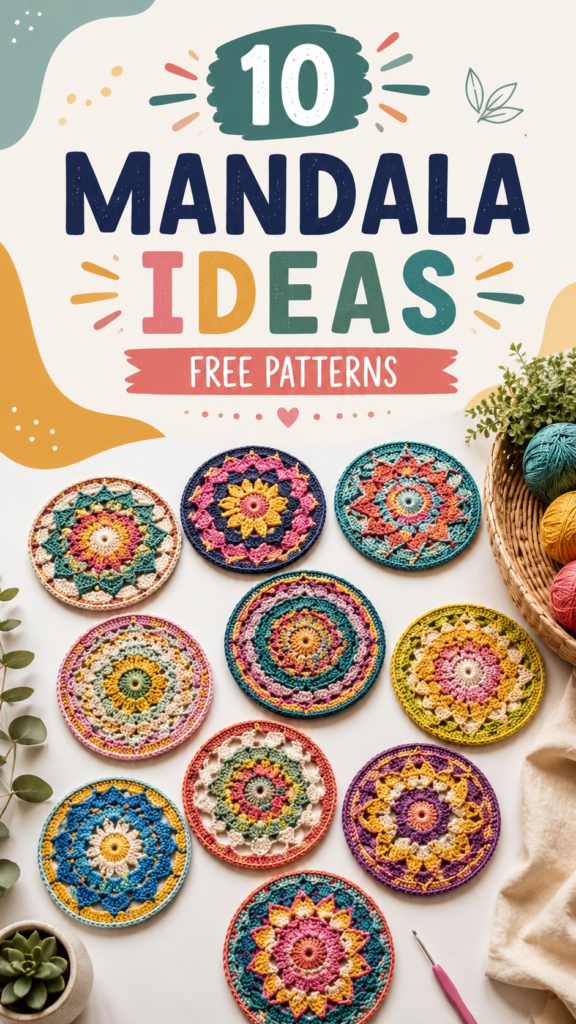
Mandala crochet is a wonderful way to turn simple yarn and stitches into colorful pieces filled with texture, rhythm, and personality. These circular designs bring together repeating motifs, layered colors, decorative edges, and interesting stitch combinations to create crochet projects that immediately catch the eye. Whether you are looking for a relaxing weekend project, a way to practice new crochet techniques, or inspiration for handmade home decor, mandala crochet offers endless creative possibilities.
The colorful designs featured here show just how much variety can be achieved with a circular crochet pattern. Some motifs use bold turquoise, pink, yellow, and purple combinations, while others lean toward softer or more earthy palettes. The repeated rounds create a beautiful visual flow, making each piece feel decorative even before it becomes part of a larger project.
Key Takeaways
- Mandala crochet is ideal for experimenting with color, texture, and repeating motifs.
- Circular designs can be made into wall decor, coasters, mats, cushions, blankets, and more.
- Changing yarn colors between rounds can dramatically transform the same basic pattern.
- Beginners can start with simple rounds before moving into more detailed motifs.
- Careful stitch counting helps keep circular crochet pieces flat and symmetrical.
- Small mandalas are excellent projects for using leftover yarn from other crochet creations.
What Makes Mandala Crochet So Appealing?
There is something especially satisfying about crocheting in the round. Instead of building a project from straight rows, you gradually create a circular composition that grows outward from the center. Each round adds another layer of color, texture, or shape, and the finished result can look surprisingly intricate.
Mandala crochet patterns are particularly appealing because they encourage creativity. You can follow a pattern closely, choose completely different colors, simplify certain rounds, or combine favorite elements from several designs. The basic circular structure gives you a dependable foundation while leaving plenty of room for personal expression.
Another advantage is the range of possible project sizes. A small mandala can be completed relatively quickly and used as a decorative accent, while a series of larger motifs can become part of a blanket, wall hanging, table decoration, or other handmade project.
Important: The beauty of mandala crochet comes from repetition with variation. Repeating shapes create visual harmony, while changes in color, stitch texture, and round design keep the finished piece interesting.
10 Mandala Crochet Ideas to Try
1. Bright Floral Mandala
Start with a cheerful floral-inspired mandala using a strong contrast between the center and outer rounds. A sunny yellow center surrounded by pink, teal, or purple stitches can create an energetic focal point. Use petal-like stitches around the middle to give the design a flower-inspired appearance.
This style works especially well as a small decorative mat, coaster, or colorful accent piece. If you want a more coordinated look, repeat two or three of the same colors throughout different rounds rather than introducing a new shade every time.
2. Jewel-Tone Crochet Mandala
For a richer appearance, combine deep teal, violet, magenta, and warm golden shades. Jewel-tone color palettes make individual stitch details stand out and can give a handmade mandala a dramatic decorative quality.
This approach is particularly effective when the pattern contains several textured rounds. The contrast between darker and brighter yarns helps define petals, points, circles, and geometric details without requiring complicated embellishments.
3. Pastel Mandala Design
Not every mandala needs bold colors. Try soft pink, pale blue, cream, muted green, lavender, or gentle yellow for a calmer look. Pastel crochet mandalas can complement bedrooms, nurseries, craft spaces, and other areas where you want a softer handmade accent.
When working with light colors, texture becomes especially important. Raised stitches, scalloped edges, small clusters, and open spaces can add dimension while keeping the overall palette delicate.
4. Rainbow Mandala Crochet
A rainbow-inspired mandala is a fun choice when you have several colorful yarns available. Arrange shades gradually around the circle or use contrasting colors to create distinct sections. The radial construction naturally lends itself to colorful transitions.
This is also a practical way to use small quantities of leftover yarn. Rather than trying to find a purpose for every partial skein, select a collection of coordinating scraps and turn them into a lively crochet mandala.
5. Geometric Mandala Motif
If floral designs are not your style, explore geometric mandala crochet patterns. Repeating points, rings, triangles, diamonds, and textured sections can produce a more structured appearance.
Geometric motifs are especially attractive when you use strong color contrast. For example, a dark outer round can frame a bright center, while alternating colors can emphasize the symmetry of the pattern.
6. Textured Crochet Mandala
Texture can make a simple color palette feel much more sophisticated. Experiment with stitches that create raised surfaces, small clusters, ridges, loops, or decorative borders. Even using only two or three colors can produce an eye-catching result when the stitch patterns change between rounds.
Textured mandalas are a great opportunity to practice unfamiliar stitches on a manageable project. Because the finished piece is relatively small, you can learn a technique without committing to a large blanket or garment.
7. Mandala Coaster Set
Turn small crochet mandalas into a coordinated coaster collection. Make several pieces using the same pattern but change the color arrangement for each one. This creates a set that feels intentionally designed without making every piece identical.
For a cohesive collection, choose a limited palette and rotate the colors between the center, middle rounds, and border. Small circular motifs can also be useful for testing color combinations before committing to a larger crochet project.
8. Decorative Wall Mandala
A larger mandala can become a striking handmade wall decoration. Once the crochet piece is complete, its circular shape naturally creates a focal point. Choose colors that complement the room or use a vibrant palette when you want the piece to stand out.
You can also create a collection of different-sized mandalas and arrange them together as a decorative gallery. Using related colors across the collection can help the individual designs look connected even when their stitch patterns differ.
9. Mandala-Inspired Table Mat
A larger circular crochet motif can work beautifully as a table mat or decorative centerpiece. Choose a sturdy yarn and a pattern with a reasonably flat construction so the finished piece sits neatly on a surface.
For everyday use, consider colors that complement your existing decor. Neutral outer rounds can soften a bright center, while colorful borders can make a simple table setting feel more playful and handmade.
10. Mandala Motifs for Larger Crochet Projects
One of the most exciting possibilities is using individual mandalas as building blocks for a larger project. Make several motifs in different color combinations and join them to create a blanket, cushion cover, decorative panel, or other textile project.
When combining motifs, think about color distribution. You can use one consistent border color to visually connect separate mandalas, or embrace a deliberately eclectic appearance by allowing every motif to have its own personality.
How to Choose Colors for a Crochet Mandala
Color selection can completely change the personality of a mandala. The same stitch pattern may look modern, vintage-inspired, playful, elegant, or earthy depending on the yarn palette.
A simple way to begin is by selecting one dominant color, one supporting shade, and one accent color. From there, add additional shades only if they improve the design. This keeps the palette controlled while still allowing plenty of visual variety.
- High contrast: Use noticeably different shades to emphasize stitch shapes and radial details.
- Analogous colors: Choose neighboring shades for a smoother, more harmonious appearance.
- Warm palette: Combine coral, orange, yellow, pink, and warm neutrals.
- Cool palette: Experiment with teal, blue, green, lavender, and soft gray.
- Mixed palette: Combine several bright shades for a playful, eclectic mandala.
Expert Insight
Before crocheting the entire mandala, place your selected yarn colors next to each other. Viewing the shades together can reveal whether you have enough contrast between neighboring rounds. A small color sample can save time and help you create a more balanced finished design.
Tips for Crocheting Mandalas Successfully
Circular crochet becomes much easier when you pay attention to tension and stitch counts from the beginning. Because each round builds on the previous one, a small mistake can become more noticeable as the motif grows.
Keep Your Stitch Count Consistent
Count stitches at the end of important rounds, especially when following a detailed pattern. Correct increases are essential for keeping a circular design flat and evenly shaped.
Watch Your Tension
Very tight stitches can cause a mandala to curl, while inconsistent tension can create uneven sections. Aim for a comfortable grip and try to maintain similar tension throughout each round.
Change Colors Carefully
Color changes are one of the defining features of many mandala crochet patterns. Keep yarn tails tidy as you work, and consider how each new shade interacts with the stitches around it.
Block the Finished Piece
If the completed mandala looks slightly uneven, blocking may help improve its shape. Blocking can be particularly useful for decorative pieces where you want the outer edge and circular form to look neat and polished.
Pro Tip: If your mandala begins to ripple, do not automatically assume the pattern is wrong. Too many increases, loose tension, or yarn characteristics can all affect the shape. Check the stitch count and tension before changing the pattern.
What Yarn and Hook Should You Use?
The best yarn depends on the intended project and the look you want to achieve. For small decorative mandalas, a smooth yarn can make individual stitches easy to see and can help intricate color changes appear clean.
A crochet hook that works comfortably with your chosen yarn is equally important. If your stitches feel extremely tight, consider adjusting your hook size or relaxing your tension. Always follow the recommendations of your particular pattern when a specific gauge is important.
For colorful mandalas, having several small amounts of yarn available can be more useful than owning a large quantity of a single color. Because each round may use a different shade, mandalas are an excellent project for building a creative scrap-yarn collection.
Creative Ways to Use Finished Crochet Mandalas
Once you have completed a collection of mandala motifs, there is no shortage of ways to use them. Their decorative circular shape makes them naturally versatile.
- Use small mandalas as colorful coasters.
- Arrange larger pieces as handmade wall decor.
- Combine multiple motifs into a crochet blanket.
- Attach a motif to a cushion or pillow cover.
- Use a large flat mandala as a decorative table mat.
- Create matching sets in different color combinations.
- Turn small motifs into thoughtful handmade gifts.
The key is to think beyond the individual motif. A single mandala can be beautiful on its own, but several coordinated motifs can become the foundation for a much larger creative project.
Why Mandala Crochet Is Great for Beginners
Although some mandala patterns contain advanced stitches, the format can still be an excellent learning tool. The projects are usually divided into manageable rounds, allowing you to practice one technique at a time.
Beginners can start with a simple circular design featuring basic stitches and gradual color changes. Once comfortable with the structure, you can explore textured stitches, decorative borders, unusual motifs, and more complex combinations.
Small projects also provide quick feedback. Instead of spending weeks on a large project, you can finish a small mandala and immediately see how your color choices and stitch techniques work together.
At a Glance
- Choose a circular pattern that matches your skill level.
- Plan your yarn colors before beginning multiple rounds.
- Count stitches regularly to maintain a balanced shape.
- Experiment with small motifs before starting larger projects.
- Use finished mandalas as decor, gifts, or building blocks for bigger designs.
Conclusion: Make Your Own Colorful Mandala Crochet Collection
Mandala crochet combines the satisfaction of handmade crafting with the freedom to experiment with color, texture, and pattern. From bright floral motifs to geometric designs and soft pastel creations, there is a style for practically every crochet enthusiast.
The collection of ideas shown here is a great reminder that you do not need an elaborate project to create something visually impressive. A carefully chosen color palette, consistent stitches, and a few creative rounds can transform ordinary yarn into a beautiful decorative motif.
Start with one small mandala, experiment with your favorite colors, and let each finished round guide the next. As your confidence grows, try larger designs, coordinated sets, and multi-motif projects. Whether you are a beginner searching for an approachable crochet project or an experienced maker looking for fresh inspiration, mandala crochet offers plenty of room to create something uniquely yours.
Tags
Mandala Crochet Crochet Mandala Crochet Patterns Colorful Crochet Crochet Ideas Crochet Decor DIY Crochet Crochet Inspiration